Focuses on an exhibition held at the National Portrait Gallery in London titled The Portrait Now.
Selected by curator Robin Gibson, focused on painting and sculpture. Overcoming the idea that abstract art was the most valid contemporary form.
Important to think about including a range of work. All media, paintings, sculptures, digital works, photographs. The portrayal of others and the self remains central in contemporary art - trying to demonstrate this through the exhibition. Not acting against traditional ideas of portraiture, but using new media to extend them. Include more conceptual and experimental works. The selection of works was not intended to be a detailed survey but to give a view of the current state of portraiture.
Idea of the portrait links to themes of identity, representation, power and nationality. Gives artists ground to depict (arguably one of the most intriguing of all subjects) ourselves and others.
Exchange of images as a result of conflict and calamity, catastrophic events eg. 9/11, 2004 Boxing Day Tsunami. First communication of these events is often images of human beings, witnesses, victims, heroes, survivors, perpetrators.
Circulation of images of actors, models and athletes (the culture of celebrity) driven forward through networks of magazines, TV, internet. Have an obsession with knowing about the private lives of the rich and famous "regarded as if they were public property".
Sam Taylor Wood, David, 2003-4 - Film made up of a series of stills of David Beckham, some playing football, or posing. One of him sleeping, particularly intimate, intrusion of personal space.
 |
| Crying Men (Daniel Craig), 2003 |
 |
| Crying Men (Daniel Craig), 2003 |
 |
| Crying Men (Laurence Fishburne), 2002 |
Idea that as the public we are anonymous, part of a sector of the unknown. Have such an interest and know so much about others who know nothing about our individual selves. The famous view us as a group, no personal information. 'Anonymity of the crowd.'
The Purpose of Portraiture:
essential question is whether the portrait is simply a record of the person, the surface, or whether it can provide insight into the subjects character, or emotion.
Chuck Close - large scale paintings of faces "as much about how to make a painting, as they are about the subject". Challenges the idea of portraiture, he admits that "people's faces are road maps of their life".
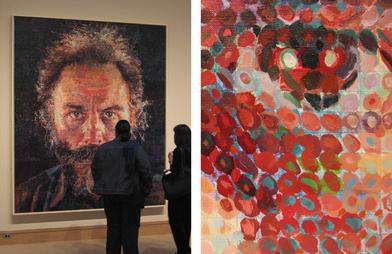 |
| Lucas I, 1986-7 |
Lucian Freud - more consciously emotive paintings. There are evident translations between the paint on the canvas and the skin, hair or cloth being depicted.
Sam Taylor Wood - already mentioned David Beckham piece. Also created a project photographing men crying. Disturb presumptions about the male public image. Images of actors - conundrum between real and invented emotion. Crying is a private emotion made public.
Terms of Portraiture:
emergence of new figurative painting and sculpture (conceptual art), art world jolted in 90s. Conceptual art taking centre stage. eg. Tracey Emin, Damien Hirst, Gary Hume, Sarah Lucas, Marc Quinn, Sam Taylor-Wood, Gillian Wearing. "Most of this work centres on ideas of selfhood and contemporary experience."
Equally important, emergence of women artists eg Susan Hiller, Ana Mendieta, Adrian Piper, Anish Kapoor, Sonia Boyce, Chris Ofili. Images of self or others have been central. Challenged the basis on which art had always been enjoyed.
 |
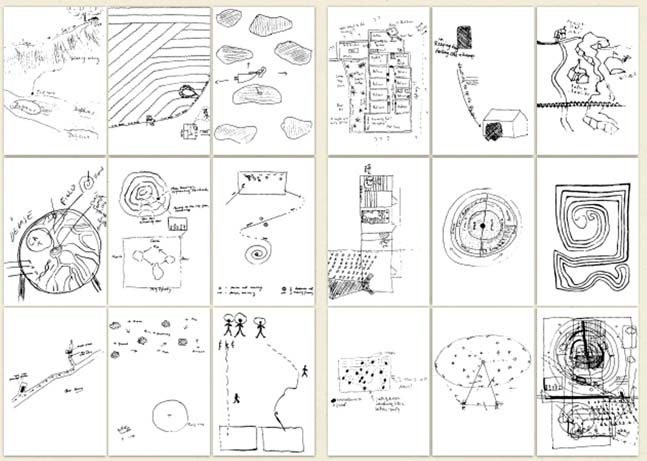
| Dream Mapping [Susan Hiller] |
 |
| Midnight Waterloo, 1987 [Susan Hiller] |
Some artists have extended the terms of portraiture with new media, other artists have found historically grounded forms of painting have given them a platform for creating outstanding traditional portraits.
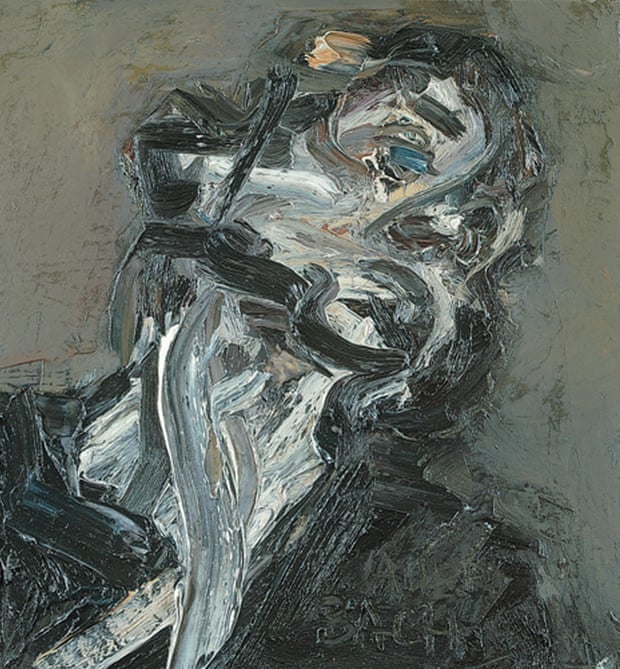
Frank Auerbach and Leon Kossoff where a face may emerge out of swirls and marks. Relies on the audience.
[See separate post on Auerbach]
Leon Kossoff:
 |
| "Head of Mother," 1965 |
 |
| English Willesden Junction - Early Morning. 1962 |
Growing appreciation of David Hockney - examines how to look at the world around him through paintings drawings and photographs.
 |
| Mum, 1990 |
 |
| Gregory Evans January 20 1997, |
Leon Golub and Marlene Dumas work figuratively with watercolour and oil. Both influential and helped extend the category of portraiture. Blurred the edges between figurative, narrative, symbolic and portrait paintings.
[see separate post for Marlene Dumas]
Leon Golub:
 |
| American, 2004 |
 |
| Reclining Youth, 2003 |
 |
| Reclining youth in public space. Hung by wire and hooks through canvas. |
Paula Rego, Germaine Greer, 1995 - attracted public attention. Writer Peter Campbell on Rego's piece: her pictures invite, demand even, that you attend to what they are about as well as how they look. Senior artists opened up areas for young artists to explore.
 |
| Germaine Greer, 1995 |
John Wonnacott, Daphne Todd, Andrew Festing create fine painted portraits for private and public commissions.
 |
| John WonnacottStudy for HRH Prince William in The White Drawing Room, [2000] |
 |
| Daphne Todd: George Corkwell, 2012 |
 |
| Me in a Magnifying Mirror, 2001 |
Not a commissioned piece, but one of her works that I feel relates more to my ideas of distortion and contemporary portraiture.
 |
| Andrew Festing: Her Majesty Queen Elizabeth II |
Younger, energetic generation of portrait painters: James Lloyd, Ishbel Myerscough, Stuart Pearson Wright.
World of art and pure photography have crossed over and created a critical and wider debate about portraiture. Photographers such as Thomas Struth and Thomas Ruff in contrast with the the provocative portraits by Robert Mapplethorpe of naked men or Andreas Serrano's study of the KKK (most controversial images of the 80s).
Identity in Portraits:
Characteristics of class, race, gender can be exposed in portraits. Disguise or reflection. Clothing, gesture, pose, narrative. Specific portrait can stand for more generic catagories and groups.
Taskmaster Morimura creates works which elaborately imitates the female subjects of great paintings.
Gillian Wearing's 'self portraits' - strange displacement. Eyes of an older wiser woman, face of a baby.
Hew Locke - jungle representation of queen Elizabeth II - portrait tangled in plastic flowers and toys - Collonial power issues being raised? Association with cheap high street goods.
John Currin exaggerated pneumatic female subjects - small town girls in retro pin up style. Stereotypes. Uneasy mix between reality and doll like depiction. Clearly not quite real, intriguing us. Domesticity.
Self portraits - exploring own identity. Audience standing between the artist and the mirror. Self image fragmented or disrupted - Catherine Opie. Lucy Jones - tensions in her body. Daphne Todd - segment of herself.
Culture absorbed into the work -